Is Rwanda or Uganda better for gorilla trekking? It’s one of the first questions new clients bring to the team at Sarafu Travel when they start planning an East Africa trip. And it’s rarely as simple as comparing two permit prices. Two countries, two very different price points, and no obviously wrong answer. The right destination depends on your fitness level and your budget. It also depends on what you want from the experience surrounding that one extraordinary hour in the forest.
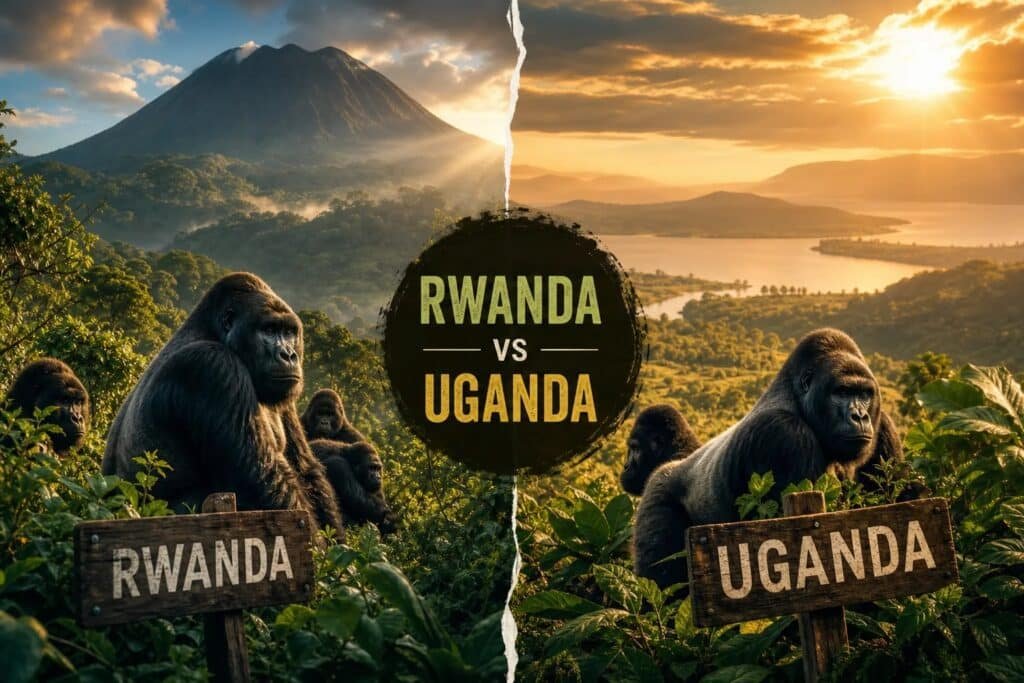
The temptation is to make this decision based purely on price. Rwanda’s permit costs $1,500; Uganda’s costs $800. The math seems straightforward. But the calculus shifts once you factor in the full picture. Think about how you’ll get there from the US, what the trail demands of your body, where you’ll sleep and what the experience feels like. The right destination is the one that fits you, not the one with the better headline number.
This guide breaks down five factors that actually drive the decision. They are permit cost and booking logistics, trek difficulty, access from the US, accommodation quality, and the gorilla experience itself. By the end, you’ll have a clear sense of which country matches your priorities.
Permit costs: the most concrete difference between Rwanda and Uganda gorilla trekking
The numbers are clear. In 2026, Rwanda charges foreign non-residents US$1,500 per person for a gorilla trekking permit. Uganda charges US$800. That $700 difference is real. For a couple, it adds up to $1,400 before you’ve booked a single night’s accommodation.
Rwanda’s higher price reflects a deliberate conservation strategy. The Rwanda Development Board has positioned Volcanoes National Park as a premium destination. Permit revenue is reinvested directly into park management and community programs. The result is a tightly managed, high-quality experience with 96 permits available per day across 12 habituated groups. Uganda’s Wildlife Authority operates on a similar model at a lower price point. It has 20 habituated groups spread across Bwindi Impenetrable National Park and Mgahinga Gorilla National Park.
Neither permit covers accommodation, park entry fees, or porter fees, which are additional costs in both countries. What you’re paying for is one access permit for a one-hour encounter with a habituated gorilla family.
When Rwanda’s price comes down
Rwanda does offer a low-season discount, but it comes with conditions. From November through May, travelers on a multi-park itinerary pay less. It must combine Volcanoes National Park with Akagera National Park or Nyungwe Forest. Permits then cost US$1,050. This isn’t available for a standalone Volcanoes-only booking, so it requires advance planning and a broader Rwanda itinerary. Uganda’s permit pricing holds steady at $800 year-round, making it more predictable for budget planning.
Gorilla permit availability and booking timelines
Both countries require advance booking. For Rwanda, plan to secure permits 3 to 6 months ahead through the RDB’s official portal or a licensed operator. Uganda’s Bwindi also fills quickly, particularly for peak months. June through September and December through January book out fastest in both countries. If your dates are flexible, the rainy months of March through May offer better permit availability in Uganda. They also coincide with Rwanda’s low-season pricing window.
Trek difficulty: Rwanda vs Uganda gorilla trekking terrain compared
This is where many travelers are caught off guard. The assumption is that both treks are broadly similar in effort. They are not. Rwanda’s Volcanoes National Park offers shorter, more defined trails on open volcanic hillside and through bamboo forest. Uganda’s Bwindi Impenetrable Forest lives up to its name in every sense.
Rwanda treks typically run 1 to 4 hours, with many groups located within a 2-hour hike from the trailhead. Trails begin at around 2,600 meters and move through relatively open terrain. For most fitness levels, including older travelers and those without a background in strenuous hiking, Rwanda is manageable and accessible.
Bwindi is a different proposition. Treks commonly run 2 to 8 hours, with some groups requiring close to a full day of effort. The challenge isn’t mainly elevation, as the Ruhija sector sits at around 2,350 meters. Instead, it’s the density and gradient of the terrain: steep, muddy, root-covered trails through thick jungle. Bwindi rewards the effort with a rawer, more immersive forest experience, but it genuinely demands physical fitness.
A practical self-assessment
Can you manage a 2 to 3 hour hike on uneven terrain without knee or joint issues? Then Rwanda is comfortable for most first-time trekkers. For Bwindi, your benchmark should be closer to 4 to 6 hours of active hiking on steep ground. Both parks offer porters for an additional fee. This makes a real difference, especially in Uganda where the terrain is much more demanding. Hiring a porter in Bwindi isn’t a concession to difficulty; it’s smart logistics.
Getting there from the US: flights and on-the-ground logistics
From any major US city, reaching either destination requires at least one connection. The routing differences matter more than most travelers expect. For Rwanda, Kigali International Airport (KGL) is the gateway. Single-connection flights run from New York, Washington, Los Angeles and other US hubs. Airlines include Ethiopian Airlines, Turkish Airlines, KLM, Brussels Airlines, Qatar Airways, and Kenya Airways. Total travel time typically runs 17 to 19 hours from New York. From Kigali, the drive to Musanze and Kinigi takes a steady 2 to 2.5 hours. The road is good tarmac all the way. A same-day arrival with a trek briefing that evening and trekking the following morning is genuinely feasible.
Uganda’s Entebbe International Airport (EBB) is the main entry point. However, Bwindi sits in the far southwest of the country. The overland transfer from Entebbe to Bwindi runs 8 to 10 hours or longer. It depends on road conditions and the sector you’re targeting. Most operators recommend a domestic charter flight from Entebbe to Kihihi or Kisoro airstrip. From the airstrip, the park is under an hour away. That domestic flight adds cost but recovers a full travel day.
There’s also a practical shortcut worth knowing: Kigali is a viable gateway for Uganda’s southern Bwindi sectors. Rushaga and Nkuringo in southern Bwindi are about 4 to 5 hours from Kigali by cross-border road transfer. For travelers combining Rwanda and Uganda on a longer itinerary, this routing makes excellent sense.
Where you’ll sleep: lodges near Volcanoes National Park and Bwindi
Accommodation sets the tone for the entire gorilla trekking experience. Rwanda has built a cluster of world-class properties near Volcanoes National Park. They rank among the finest wildlife lodges on the continent. Bisate Lodge, Singita Kwitonda Lodge, Virunga Lodge, One&Only Gorilla’s Nest, and Sabyinyo Silverback Lodge anchor the luxury end. Top-tier rates run from $800 to well over $2,000 per person per night. Mid-range options like Five Volcanoes Boutique Hotel and Le Bambou Gorilla Village cost $100 to $400 per night. Budget guesthouses in Musanze start around $50 to $120 per night.
Uganda’s lodges near Bwindi are more affordable across all tiers. Their setting right beside the forest also has its own appeal. The mid-range and budget segments offer stronger relative value than Rwanda’s equivalent price points. Luxury options exist near Bwindi, though without the same concentration of ultra-premium properties found around Volcanoes. Do you want to keep total trip cost manageable without losing a genuine experience? Then Uganda’s broader range of lodges is a real advantage.
The experience itself: one hour that doesn’t compare
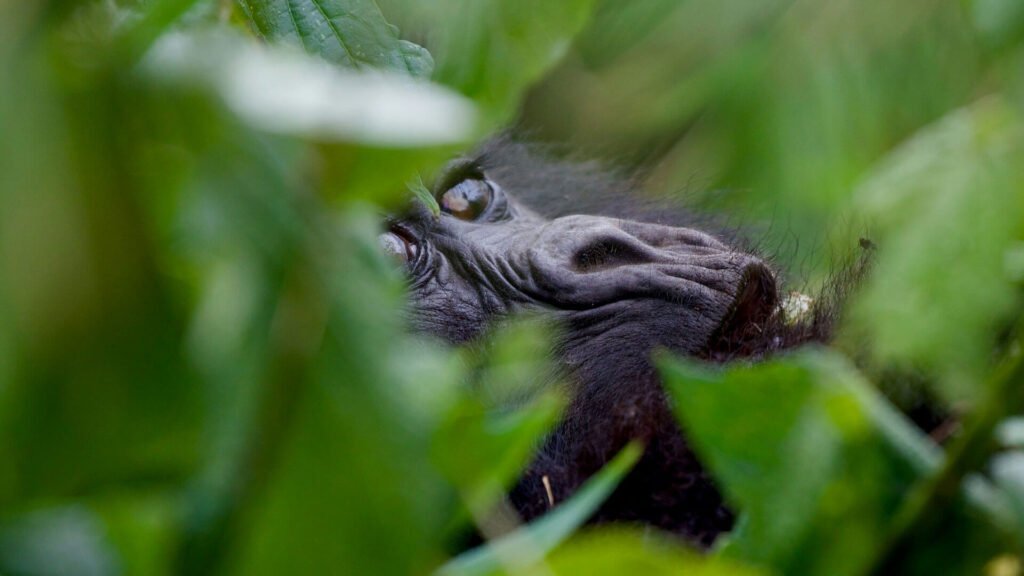
Both countries follow the same ground rules. You get one hour with a habituated gorilla family, strict group size limits, and a minimum approach distance to protect the animals. What differs is the context surrounding that hour.
Rwanda’s 12 habituated groups and 96 daily permits create a structured, efficiently managed experience. Briefings are organized and logistics are smooth. The lodges are set up to deliver a seamless luxury encounter from start to finish. Uganda’s 20 habituated groups across multiple Bwindi sectors give the experience a wilder, less crowded feel. However, the trek to reach a group is usually far more demanding. Bwindi’s Buhoma sector is the most accessible and books out fastest. Rushaga and Nkuringo offer more availability and a more remote atmosphere.
Rwanda’s commitment to gorilla conservation shows clearly in its infrastructure and park briefings. It also shows in the lodge quality around Volcanoes National Park. Uganda’s Bwindi is rawer, less polished, and more unfiltered. Neither is better in an absolute sense. The choice comes down to what you value: a curated luxury encounter, or a rugged immersion in one of Africa’s great forests.
Is Rwanda or Uganda better for gorilla trekking? Which destination is right for you?
Rwanda is the better choice if you want easy access from the US, luxury lodges and a shorter, easier trek. It also suits travelers with older family members, joint concerns, or a wish for the smoothest possible experience. Rwanda also makes sense if you add Kigali city time, a Nyungwe chimpanzee extension, or a Zanzibar beach finish. This is the kind of itinerary that Sarafu Travel specializes in. Our Rwanda gorilla trekking packages are built around people who want the encounter done beautifully. There is no compromise on comfort or logistics.
Uganda is the better choice if you have a tighter total budget and good fitness. It also suits you if you want Bwindi’s more challenging, less structured forest immersion. Uganda also suits travelers building a longer East Africa itinerary that includes Queen Elizabeth National Park or a Kibale chimpanzee experience. Sarafu Travel designs Uganda itineraries with the same level of care and customization as any Rwanda trip.
When clients weigh both options, we start with three things. These are your fitness level, your total trip budget beyond the permit, and the experience you want around the trek. Those answers typically point clearly to one destination. Our team has helped hundreds of American travelers with this decision. We design each itinerary around your priorities, not a pre-packaged template. If you’re ready to start planning, reach out for a personalized recommendation.
The bottom line: which country is better for gorilla trekking?
So, is Rwanda or Uganda better for gorilla trekking? The honest answer is that both countries deliver one of the most profound wildlife experiences on earth. Each suits a different type of traveler for practical reasons. The permit cost difference is meaningful, but it’s rarely the deciding factor. Weigh the full picture: how you’ll get there, what the trail demands, where you’ll sleep, and the experience you want.
The best gorilla trekking trip is the one designed around the traveler. Getting that right, from the first permit to the last game drive, is what Sarafu Travel exists to do.